The Complete Guide to Fintech Compliance & Risk Management: Owning Your Regulatory Destiny
By Tyler Ferguson, COO, Chisel | 16 min read
Table of Contents
Introduction
Understanding Third-Party Compliance Risk
The Regulatory Landscape Is Changing
Building Your Compliance Program
Transaction Monitoring and AML
Compliance Technology Stack
Operational Resilience and BCP
Compliance Team Structure
Common Compliance Pitfalls
The Future of Fintech Compliance
Conclusion: Compliance as Competitive Advantage
Frequently Asked Questions
Related Resources
About the Author
Introduction
Recent industry challenges have exposed a critical vulnerability in the fintech ecosystem: compliance programs you don't control create risks you can't manage. When middleware providers face regulatory scrutiny, their compliance failures cascade to every client—regardless of individual company compliance quality.
I've spent 15 years in financial services compliance, from traditional banking to fintech startups. I've navigated regulatory examinations, built compliance programs from scratch, and witnessed the evolution of fintech compliance management from an afterthought to a strategic imperative. The single biggest mistake I see companies make is outsourcing compliance thinking along with compliance operations.
The Compliance Crisis:
Third-party compliance dependencies have proven to be one of the highest-risk aspects of fintech operations. Recent infrastructure incidents have demonstrated that when middleware providers encounter regulatory challenges, all their clients face immediate consequences. This isn't just operational risk—it's existential risk disguised as convenience.
What This Guide Covers:
Understanding third-party compliance risk and why it's fundamentally uninsurable
The regulatory landscape shift toward direct accountability and transparency
Building your own comprehensive compliance program from the ground up
BSA/AML compliance, KYC, transaction monitoring, and consumer protection frameworks
Operational resilience and business continuity planning requirements
Future regulatory trends and proactive preparation strategies
My Promise to You:
Regulatory compliance ownership isn't just risk mitigation—it's competitive advantage. Companies with owned compliance programs move faster, take calculated risks, and build sustainable businesses while their competitors struggle with vendor limitations and inherited problems.
Compliance isn't optional. But neither is competitive advantage. This guide shows you how to achieve both.
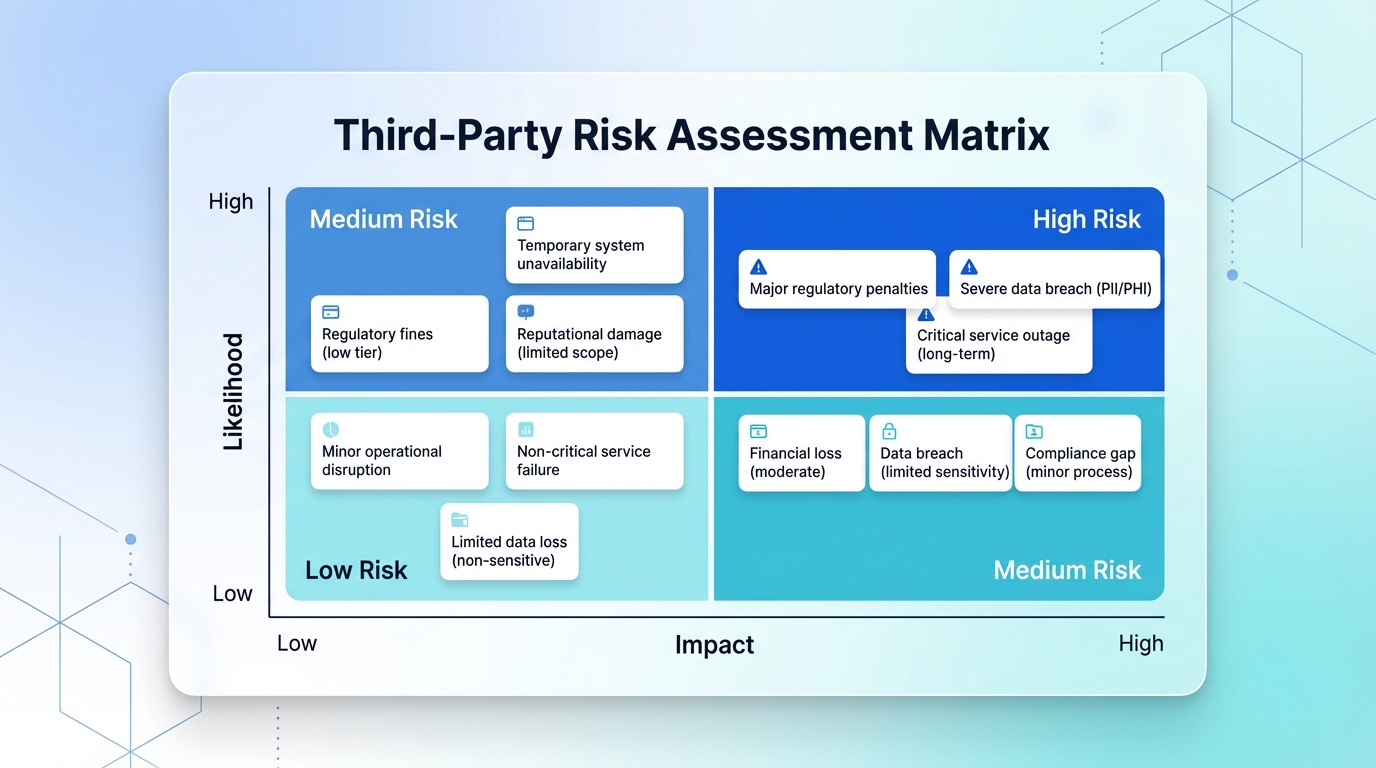
Third-Party Risk Assessment Matrix
Understanding Third-Party Compliance Risk
What Is Third-Party Compliance Risk?
Third-party compliance risk occurs when your company's regulatory standing depends on another organization's compliance program performance. In fintech, this typically manifests through middleware providers who manage banking relationships, compliance monitoring, and regulatory reporting on behalf of multiple clients.
The Fundamental Problem:
When you delegate compliance responsibility to a third party, you inherit their entire risk profile without visibility or control. Their weaknesses become your vulnerabilities. Their failures become your crises.
The Hidden Compliance Dependencies in Middleware Models
Most fintechs don't realize the extent of their compliance dependencies until something goes wrong. Here's what's actually happening behind the middleware curtain:
BSA/AML Program Dependency:
- Your transaction monitoring relies on their rules and thresholds
- Suspicious Activity Reports (SARs) are filed under their program, not yours
- You have no direct relationship with regulators
- Customer due diligence procedures follow their standards, not your risk appetite
Regulatory Communication Dependency:
- All regulatory correspondence goes through the middleware provider
- You have no direct dialogue with examination teams
- Regulatory guidance interpretation is filtered through their perspective
- Compliance program changes require their approval and implementation
Data and Documentation Dependency:
- Compliance records are stored in their systems
- Audit trails may be incomplete or inaccessible
- Regulatory reporting depends on their data quality and timeliness
- Evidence of compliance relies on their documentation standards
Why Third-Party Compliance Risk Is Uninsurable
Compliance risk cannot be transferred through contracts or insurance because regulatory accountability cannot be delegated. Here's why:
Regulatory Principle of Direct Accountability:
Federal banking regulators hold the licensed entity (the bank) directly accountable for compliance program effectiveness. Banks, in turn, require direct accountability from their fintech partners. Middleware creates a layer of indirection that regulators view with increasing skepticism.
Concentration Risk Multiplication:
When hundreds of fintechs depend on the same middleware provider's compliance program, any significant issue creates industry-wide disruption. This systemic concentration risk is uninsurable because it affects all policies simultaneously.
Reputation Risk Contamination:
Compliance failures generate regulatory attention and negative publicity that affects all clients of the middleware provider. Your brand becomes associated with problems you didn't create and cannot independently resolve.
Recent Industry Examples (Without Naming Companies)
Case Study: The Infrastructure Incident
A major middleware provider faced regulatory scrutiny over its BSA/AML program effectiveness. Within weeks:
- All client fintechs faced restricted banking relationships
- New customer onboarding was suspended industry-wide
- Existing customers experienced service disruptions
- Media coverage affected every client's brand reputation
- Regulatory examinations were triggered at multiple client companies
The clients had no control over the situation, no direct relationship with regulators, and no independent compliance program to fall back on.
Case Study: The Data Breach
Another significant middleware provider experienced a data security incident affecting customer personally identifiable information (PII). The cascade effects included:
- Regulatory reporting requirements for all client fintechs
- Customer notification and credit monitoring costs
- Enhanced examination scrutiny for all clients
- Increased compliance monitoring requirements
- Potential enforcement actions affecting the entire client base
The Regulatory Perspective on Third-Party Risk
Federal banking regulators have issued increasingly pointed guidance about third-party risk management:
OCC Bulletin 2013-29 emphasizes that banks cannot outsource accountability for critical functions, including compliance monitoring and BSA/AML program execution.
Federal Reserve SR 13-19 requires banks to maintain direct oversight of third-party relationships that perform critical functions.
FDIC FIL-44-2008 (updated guidance) stresses that banks must ensure third-party service providers meet the same standards as internal operations.
The Clear Message:
Regulators want to see direct accountability, not layers of delegation. They view middleware arrangements with suspicion because they obscure responsibility and create concentration risk.
Quantifying Compliance Risk: A Framework
Risk Assessment Matrix for Third-Party Compliance:
High Risk Indicators:
- Single middleware provider for critical compliance functions
- No direct regulatory relationships
- Limited compliance program visibility
- Shared resources across multiple clients
- Concentration of industry volume in one provider
Medium Risk Indicators:
- Some direct compliance functions but middleware dependency for core elements
- Limited but existing regulatory dialogue
- Partial compliance program control
- Mixed direct and third-party relationships
Low Risk Indicators:
- Direct compliance program ownership
- Established regulatory relationships
- Full visibility into compliance operations
- Diversified vendor relationships for non-critical functions
- Independent compliance program validation
Risk Quantification:
Companies can assess their third-party compliance risk by calculating the percentage of critical compliance functions dependent on external providers. Our research shows that fintechs with more than 60% third-party compliance dependency face substantially higher regulatory risk and longer incident recovery times.
The Regulatory Landscape Is Changing
Federal Banking Regulator Priorities
The regulatory environment has fundamentally shifted toward direct accountability and operational transparency. Recent examination priorities make this clear:
Enhanced Third-Party Risk Management:
The OCC, Federal Reserve, and FDIC have all elevated third-party risk management to a top examination priority. Examiners are specifically looking for:
- Direct oversight of critical functions
- Clear accountability frameworks
- Comprehensive due diligence processes
- Ongoing monitoring and performance measurement
- Contingency planning for third-party failures
Operational Resilience Focus:
Inspired by international regulatory developments, U.S. regulators are emphasizing operational resilience—the ability to deliver critical operations through disruption. This requires:
- Redundant systems and processes
- Business continuity planning
- Incident response capabilities
- Recovery time objectives for critical functions
Recent Guidance on Third-Party Risk Management
OCC Guidance on Third-Party Risk Management (Updated 2023):
- Banks must maintain the same level of oversight for outsourced functions as internal functions
- Critical functions cannot be delegated without maintaining direct accountability
- Concentration risk must be actively managed and mitigated
- Business continuity planning must account for third-party dependencies
Federal Reserve Guidance on Fintech Partnerships:
- Banks must demonstrate direct understanding of fintech partner operations
- Compliance program effectiveness cannot be assumed through contracts
- Regular independent validation of third-party compliance programs is required
- Clear escalation and communication procedures must be established
FDIC Technology Service Provider Guidance:
- Enhanced due diligence requirements for fintech partnerships
- Ongoing monitoring and performance measurement requirements
- Incident response and business continuity planning obligations
- Regular assessment of concentration risk and alternative arrangements
The Shift Toward Direct Accountability
What's Driving the Change:
Regulatory Lessons from Traditional Banking:
Regulators have observed that outsourced compliance functions often become compliance gaps. When banks delegate compliance responsibilities, they frequently lose the expertise and oversight necessary to ensure effectiveness.
Fintech Scale and Complexity:
As fintechs have grown in size and complexity, regulators have realized that traditional vendor management approaches are insufficient for critical functions like compliance monitoring.
Systemic Risk Concerns:
The concentration of multiple large fintechs with single middleware providers creates systemic risk that regulators want to mitigate through direct oversight and accountability.
What Regulators Want to See
In Regulatory Examinations, Federal Banking Regulators Consistently Look For:
Direct Program Ownership:
- Compliance officer with direct program responsibility
- Board-level oversight and governance
- Regular compliance program assessment and testing
- Independent validation of program effectiveness
Clear Accountability Frameworks:
- Defined roles and responsibilities for compliance functions
- Direct communication channels with regulatory authorities
- Escalation procedures for compliance issues
- Regular reporting and documentation practices
Comprehensive Risk Management:
- Risk assessment methodologies tailored to business model
- Ongoing monitoring and testing procedures
- Incident response and corrective action processes
- Regular training and competency development
Operational Independence:
- Ability to continue critical functions during vendor disruptions
- Alternative arrangements for critical compliance functions
- Independent data and documentation retention
- Direct relationships with essential service providers
State-Level Regulatory Considerations
Money Transmitter License (MTL) Requirements:
Most states require money transmitter licensees to maintain direct compliance programs, including:
- Designated compliance officer
- BSA/AML program documentation
- Customer identification and due diligence procedures
- Transaction monitoring and reporting capabilities
- Regular compliance training programs
State Examination Focus Areas:
- California DFPI: Emphasizes consumer protection and data privacy compliance
- New York DFS: Focuses on cybersecurity and operational resilience
- Texas DBI: Prioritizes BSA/AML program effectiveness and documentation
- Florida OFR: Concentrates on third-party risk management and vendor oversight
International Compliance for Global Fintechs
European Union Regulatory Requirements:
Payment Services Directive 2 (PSD2):
- Strong customer authentication requirements
- Open banking compliance obligations
- Operational incident reporting requirements
- Third-party provider oversight responsibilities
General Data Protection Regulation (GDPR):
- Data protection impact assessments
- Privacy by design requirements
- Cross-border data transfer restrictions
- Data subject rights and breach notification obligations
UK Financial Conduct Authority (FCA) Requirements:
- Senior Managers and Certification Regime (SMCR) compliance
- Operational resilience framework implementation
- Consumer duty obligations
- Financial crime prevention requirements
Regulatory Examination Preparation
Proactive Examination Readiness:
Documentation Preparation:
- Current compliance program documentation
- Risk assessment and testing results
- Training records and competency assessments
- Incident reports and corrective action documentation
- Vendor management and oversight records
Process Demonstration:
- Transaction monitoring system demonstrations
- Customer due diligence procedure walkthroughs
- Suspicious activity identification and reporting processes
- Customer complaint handling and resolution procedures
- Business continuity and disaster recovery testing results
Stakeholder Availability:
- Compliance officer availability for interviews
- Key personnel familiar with program operations
- Board members or senior management for governance discussions
- Third-party vendor representatives if applicable
The Bottom Line on Regulatory Change:
The regulatory environment is shifting decisively toward direct accountability and transparency. Fintechs that position themselves ahead of this trend will find examination processes smoother, regulatory relationships more collaborative, and business operations more resilient.
Building Your Compliance Program
The Core Components of Fintech Compliance
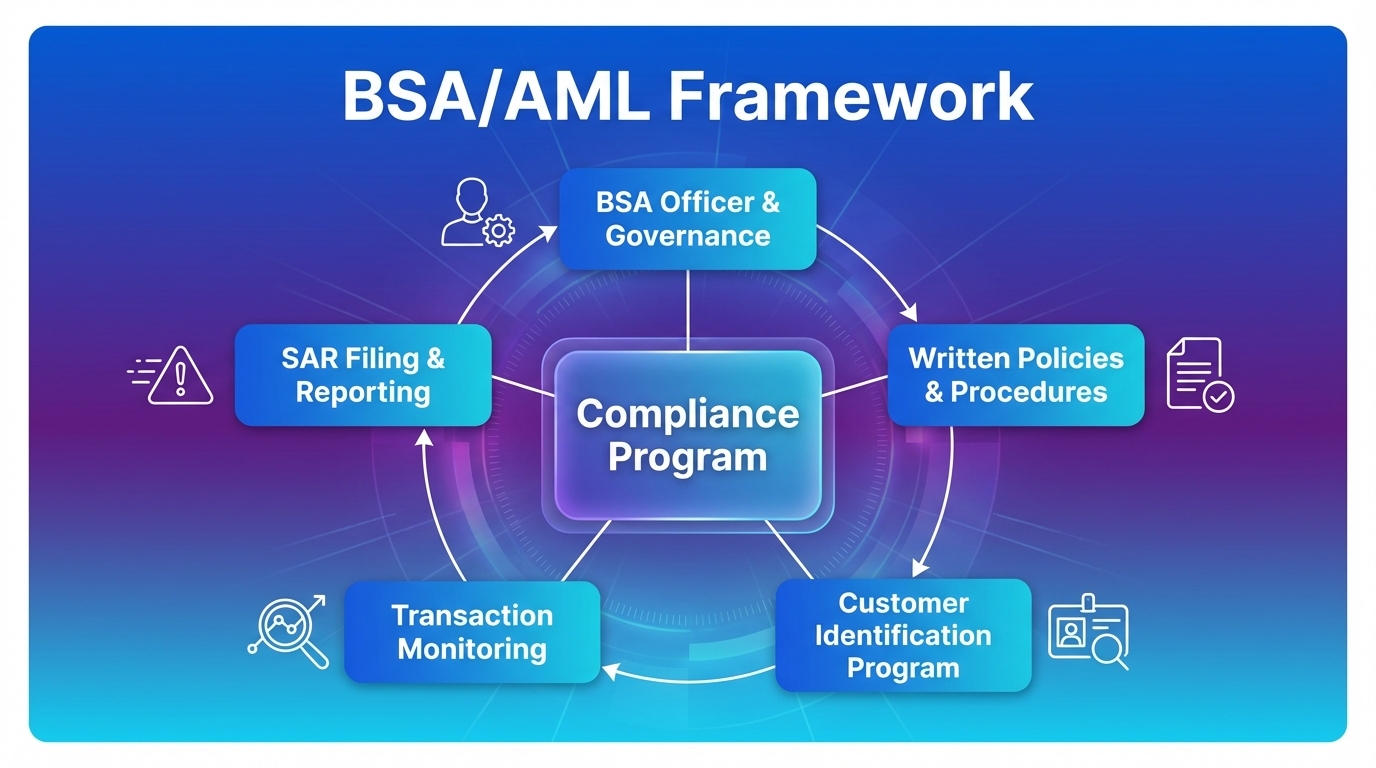
A comprehensive fintech compliance program consists of five foundational elements that work together to ensure regulatory compliance and risk management effectiveness:
1. Bank Secrecy Act (BSA) and Anti-Money Laundering (AML) Program
2. Customer Identification and Due Diligence Program
3. Transaction Monitoring and Suspicious Activity Reporting
4. Consumer Protection and Fair Lending Compliance
5. Data Privacy and Cybersecurity Framework
Each component must be designed, implemented, and maintained with your specific business model and risk profile in mind. Cookie-cutter approaches don't work in fintech compliance management because every business model creates unique risks and regulatory requirements.
BSA/AML Program Design and Implementation
Program Foundation:
Your BSA/AML program serves as the cornerstone of your regulatory compliance ownership strategy. It must be comprehensive, risk-based, and tailored to your specific customer base and transaction patterns.
Essential Program Elements:
Risk Assessment and Customer Risk Rating:
- Comprehensive analysis of your customer demographics and behavior patterns
- Geographic risk assessment based on customer locations and transaction destinations
- Product and service risk evaluation specific to your offerings
- Delivery channel risk assessment (mobile, web, API-based services)
Customer Identification Program (CIP):
- Identity verification procedures appropriate for your customer acquisition process
- Documentation requirements that balance security with customer experience
- Verification timing standards that meet regulatory requirements
- Record retention procedures for identification documents and verification results
Customer Due Diligence (CDD) Procedures:
- Initial customer due diligence requirements for account opening
- Ongoing due diligence procedures for existing customers
- Enhanced due diligence procedures for higher-risk customers
- Beneficial ownership identification for entity customers
Transaction Monitoring Program:
- Automated monitoring rules calibrated for your transaction patterns
- Manual review procedures for unusual or suspicious activity
- Alert investigation and case management processes
- Documentation standards for monitoring decisions
Suspicious Activity Reporting:
- SAR decision-making criteria and approval processes
- Filing procedures and timeline requirements
- Continuing activity monitoring and follow-up reporting
- Law enforcement cooperation procedures
Know Your Customer (KYC) Procedures
Risk-Based KYC Framework:
Customer Risk Categories:
- Low Risk: Standard verification procedures, basic ongoing monitoring
- Medium Risk: Enhanced verification requirements, periodic review procedures
- High Risk: Comprehensive verification, enhanced due diligence, frequent monitoring
Verification Standards:
- Document-based verification using government-issued identification
- Non-documentary verification through third-party databases
- Biometric verification for enhanced security where appropriate
- Address verification through utility bills or bank statements
Customer Identification Program (CIP)
Minimum Identification Requirements (31 CFR 1020.220):
For Individual Customers:
- Full legal name
- Date of birth
- Physical address (not a P.O. Box)
- Social Security Number or Individual Taxpayer Identification Number
For Entity Customers:
- Legal business name and any trade names
- Business address
- Employer Identification Number (EIN)
- Beneficial ownership information (25% or greater ownership)
Verification Timeline:
- Verification must be completed within a reasonable time after account opening
- Temporary accounts may be opened pending verification completion
- Account restrictions should be applied until verification is complete
- Documentation of verification attempts and results must be maintained
Customer Due Diligence (CDD) and Enhanced Due Diligence (EDD)
Standard Due Diligence Requirements:
Customer Profile Development:
- Expected transaction patterns and volumes
- Source of funds and wealth where relevant
- Business or employment information
- Geographic locations of expected activity
Ongoing Due Diligence:
- Periodic review of customer information and account activity
- Transaction monitoring and pattern analysis
- Customer information updates and verification
- Risk rating adjustments based on behavior changes
Enhanced Due Diligence Triggers:
- Politically Exposed Persons (PEPs) and their associates
- Customers from high-risk geographic locations
- High-risk business types (money services businesses, cryptocurrency exchanges)
- Customers with unusual transaction patterns or volumes
Ongoing Monitoring and Suspicious Activity Reporting
Monitoring System Architecture:
Real-Time Transaction Screening:
- OFAC sanctions list screening for all parties to transactions
- Velocity checks for unusual transaction frequency or amounts
- Geographic screening for restricted or high-risk locations
- Pattern analysis for structuring or other suspicious behaviors
Periodic Account Review:
- Monthly review of high-risk accounts
- Quarterly review of medium-risk accounts
- Annual review of low-risk accounts
- Event-triggered reviews for significant account changes
SAR Filing Requirements:
- $5,000 threshold for known or suspected criminal violations
- $25,000 threshold for suspicious transactions without known criminal activity
- No minimum threshold for violations involving BSA compliance
- 30-day filing requirement from initial detection
Office of Foreign Assets Control (OFAC) Compliance
Sanctions Screening Program:
Required Screening:
- Customer onboarding screening against all OFAC lists
- Real-time transaction screening for all parties
- Periodic rescreening of existing customers
- Beneficial owner screening for entity customers
List Management:
- Daily updates of OFAC sanctions lists
- Integration of consolidated screening lists
- Alert management and false positive handling
- Escalation procedures for potential matches
Blocking and Reporting Requirements:
- Immediate blocking of property and transactions
- OFAC reporting within 10 business days
- License application procedures where appropriate
- Record keeping for blocked property and transactions
Consumer Protection and Fair Lending
Regulation E (Electronic Fund Transfers):
- Error resolution procedures and timeline requirements
- Provisional credit procedures for disputed transactions
- Consumer notification and disclosure requirements
- Liability limitations and consumer protection standards
Fair Credit Reporting Act (FCRA) Compliance:
- Adverse action notice requirements
- Consumer report user obligations
- Identity theft prevention and response procedures
- Record retention requirements for credit decisions
Truth in Lending Act (TILA) and Regulation Z:
- Credit product disclosure requirements
- Annual percentage rate (APR) calculation and disclosure
- Periodic statement requirements
- Right of rescission procedures where applicable
Data Privacy and Security Compliance
Gramm-Leach-Bliley Act (GLBA) Requirements:
Privacy Rule Compliance:
- Privacy notice delivery and content requirements
- Opt-out procedures for information sharing
- Third-party service provider oversight
- Consumer access and correction rights
Safeguards Rule Implementation:
- Information security program development and implementation
- Access controls and user authentication procedures
- Data encryption and transmission security
- Incident response and breach notification procedures
State Privacy Law Compliance:
California Consumer Privacy Act (CCPA) and California Privacy Rights Act (CPRA):
- Consumer rights to know, delete, and opt-out
- Data minimization and purpose limitation requirements
- Third-party sharing disclosures and restrictions
- Sensitive personal information protection requirements
Building an effective compliance program requires significant investment in people, processes, and technology. However, the alternative—dependence on third-party compliance programs—creates risks that far exceed the investment required for program ownership.
Transaction Monitoring and AML
Designing Effective Transaction Monitoring Systems
Transaction monitoring forms the operational backbone of your BSA/AML program. An effective system must balance regulatory compliance with customer experience while providing actionable intelligence about potentially suspicious activity.
System Architecture Principles:
Risk-Based Monitoring:
Your monitoring rules should reflect your actual customer base and transaction patterns, not generic industry templates. A payments company serving small businesses needs different monitoring thresholds than a neobank serving retail consumers.
Real-Time and Batch Processing:
- Real-time screening: OFAC sanctions, velocity limits, geographic restrictions
- Batch processing: Pattern analysis, peer group comparisons, trend identification
- Hybrid approach: Event-triggered reviews combining real-time alerts with historical analysis
Data Quality and Completeness:
Monitoring effectiveness depends entirely on data quality. Your system must capture:
- Complete transaction details including parties, amounts, and purposes
- Customer profile information including expected activity patterns
- Geographic information for all parties and locations
- Timing patterns including frequency and seasonality
Rule Development and Calibration
Developing Effective Monitoring Rules:
Threshold-Based Rules:
- Cash Activity: Currency Transaction Reports (CTRs) at $10,000, monitoring at lower thresholds
- Aggregate Activity: Daily, weekly, and monthly volume thresholds based on customer risk profiles
- Velocity Limits: Transaction frequency limits based on historical patterns
- Amount Deviations: Unusually large or small transactions relative to customer norms
Pattern-Based Rules:
- Structuring Detection: Multiple transactions just below reporting thresholds
- Rapid Movement: Funds deposited and immediately withdrawn or transferred
- Geographic Anomalies: Transactions in unusual locations for the customer
- Time-Based Patterns: Transactions outside normal business hours or patterns
Rule Calibration Best Practices:
Statistical Analysis:
- Analyze at least 12 months of transaction data to establish baselines
- Use percentile analysis to set thresholds (typically 95th or 99th percentile)
- Account for seasonal variations and business cycle impacts
- Segment analysis by customer type and risk rating
Alert Volume Management:
- Target alert rates of 1-3% of total transactions for most rule types
- Higher alert rates acceptable for high-risk customer segments
- Balance false positive rates with regulatory coverage requirements
- Regular calibration reviews to maintain effectiveness
Alert Investigation and Case Management
Investigation Workflow:
Level 1 Review (Initial Screening):
- Automated data gathering and alert enrichment
- Initial risk assessment based on customer profile
- Standard deviation analysis from normal patterns
- Preliminary disposition recommendation
Level 2 Review (Detailed Analysis):
- Comprehensive transaction pattern analysis
- Customer communication and information gathering
- External database searches and verification
- Enhanced due diligence procedures where warranted
Level 3 Review (Senior Review and Decision):
- BSA Officer or senior compliance review
- SAR filing decision and approval
- Account action recommendations (monitoring, restriction, closure)
- Law enforcement referral considerations
Investigation Timeline Standards:
- Level 1 reviews: 3-5 business days
- Level 2 reviews: 7-10 business days
- Level 3 reviews: 3-5 business days
- Total investigation cycle: 15-20 business days maximum
Suspicious Activity Report (SAR) Filing
SAR Decision Framework:
Filing Thresholds:
- Known Criminal Activity: Any amount, regardless of threshold
- Suspected Criminal Activity: $5,000 minimum threshold
- Suspicious Transactions: $25,000 minimum threshold
- BSA Violations: No minimum threshold required
Quality Standards:
- Clear, concise narrative describing the suspicious activity
- Specific dates, amounts, and parties involved
- Analysis of why the activity is suspicious
- Steps taken to investigate and verify information
Filing Procedures:
- BSA Officer approval required for all SAR filings
- 30-day filing deadline from initial detection
- Continuing activity monitoring and supplemental reporting
- Coordination with law enforcement when requested
Currency Transaction Report (CTR) Requirements
Filing Obligations:
- All currency transactions over $10,000 in a single business day
- Multiple transactions that aggregate to over $10,000
- Exemption procedures for eligible commercial customers
- International transportation of currency over $10,000
Information Requirements:
- Complete customer identification information
- Detailed transaction information including purpose
- Conducting person information if different from customer
- Financial institution information and location
Travel Rule Compliance for Crypto
For fintechs handling cryptocurrency transactions, the Travel Rule requires:
Information Transmission:
- Originator information (name, address, account number)
- Beneficiary information (name, address, account number)
- Transaction amount and date
- Unique transaction identifier
Threshold Requirements:
- $3,000 threshold for information transmission and recordkeeping
- $10,000 threshold for verification of beneficiary information
- Enhanced due diligence for higher-risk transactions
- Special attention to privacy coin transactions
Real-Time vs. Batch Monitoring
Real-Time Monitoring Advantages:
- Immediate detection and potential blocking of prohibited transactions
- Prevention of suspicious activity completion
- Enhanced customer protection from fraud
- Regulatory preference for proactive controls
Batch Monitoring Advantages:
- More sophisticated pattern analysis capabilities
- Historical trend analysis and peer group comparisons
- Lower system resource requirements
- More comprehensive data analysis possibilities
Optimal Approach:
Most effective monitoring programs use a combination:
- Real-time screening for sanctions, velocity, and geographic restrictions
- Batch processing for pattern analysis and relationship mapping
- Event-triggered analysis combining both approaches
Technology Considerations:
System Performance Requirements:
- Real-time processing must complete within 100-200 milliseconds
- Batch processing should complete within 24 hours
- Alert generation and distribution must be immediate
- Historical data analysis should support 3-5 year lookbacks
Integration Requirements:
- Core banking system integration for transaction data
- Customer information system integration for profile data
- Case management system integration for workflow
- Regulatory reporting system integration for automated filing
The Bottom Line on Transaction Monitoring:
Effective AML monitoring requires significant investment in technology, processes, and expertise. However, it's the core operational component of your BSA/AML program and the foundation of your regulatory compliance strategy. Get this right, and everything else becomes manageable.
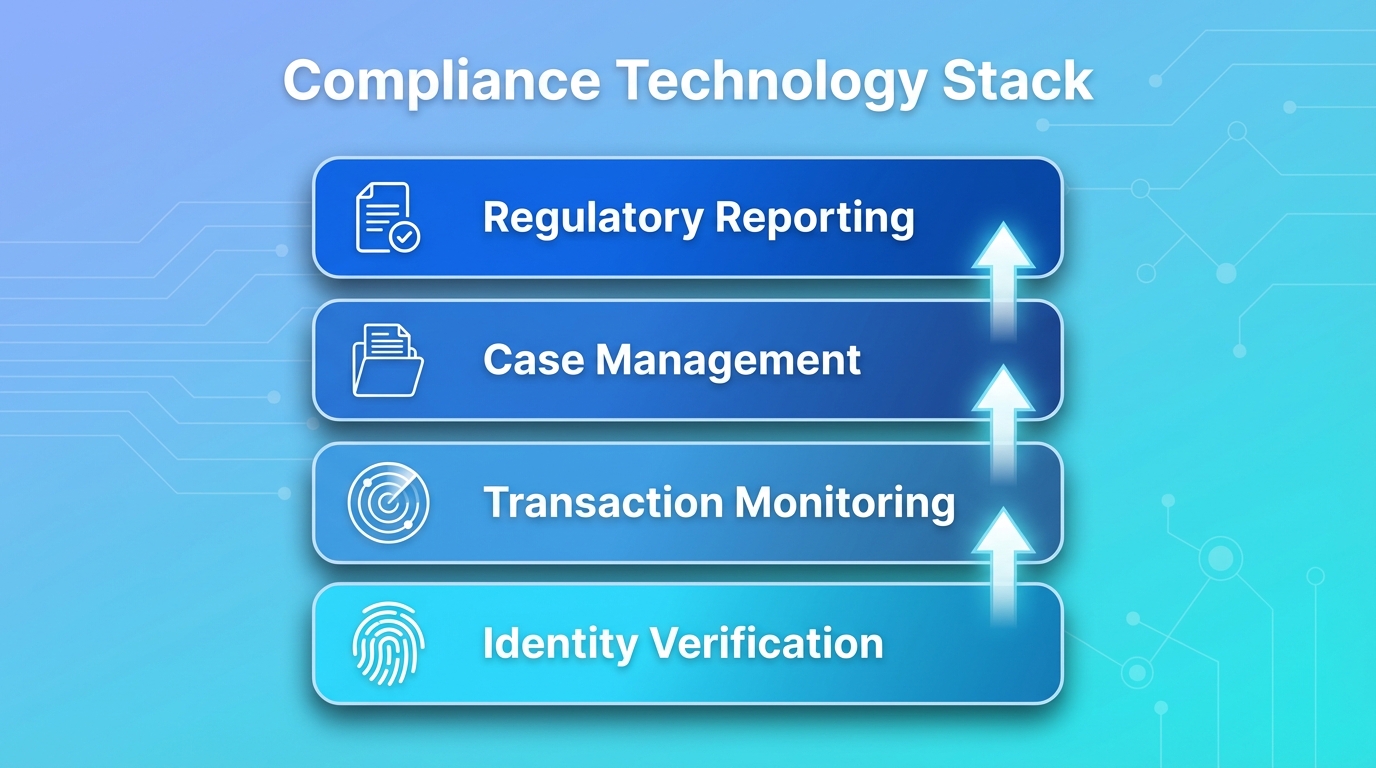
Compliance Technology Stack
Modern Compliance Tools and Platforms
Building an effective compliance technology stack requires balancing comprehensive coverage, operational efficiency, and cost management. The goal is to create an integrated platform that automates routine tasks while providing sophisticated analysis capabilities for complex compliance challenges.
Core Technology Categories:
1. Identity Verification and KYC Platforms
2. Transaction Monitoring and AML Solutions
3. Sanctions Screening and OFAC Compliance Tools
4. Case Management and Workflow Systems
5. Regulatory Reporting and Analytics Platforms
6. Data Management and Integration Infrastructure
Identity Verification and KYC Technology
Document-Based Verification Solutions:
Leading Platforms:
- Jumio: Real-time document verification with biometric matching
- Onfido: AI-powered identity verification with fraud detection
- Shufti Pro: Global coverage with manual review capabilities
- IDology (Acxiom): Knowledge-based authentication and verification
Evaluation Criteria:
- Geographic coverage and document type support
- Real-time processing capabilities and response times
- False positive and false negative rates
- Integration complexity and API quality
- Compliance with regulatory verification requirements
Database Verification Solutions:
- LexisNexis RiskNarrative: Comprehensive identity and risk assessment
- Experian CrossCore: Identity verification with fraud prevention
- TransUnion TrueVision: Multi-layered identity authentication
- Early Warning Services: Bank account verification and fraud prevention
Biometric Verification:
- Facial recognition matching for document and live photo comparison
- Voice biometrics for ongoing customer authentication
- Behavioral biometrics for continuous fraud monitoring
- Device fingerprinting for account takeover prevention
Transaction Monitoring Software
Enterprise AML Platforms:
NICE Actimize (IFM-X):
- Comprehensive transaction monitoring with behavioral analytics
- Real-time screening and batch processing capabilities
- Advanced case management and investigation tools
- Regulatory reporting and analytics dashboards
SAS Anti-Money Laundering:
- Statistical modeling and machine learning capabilities
- Scenario-based monitoring with adaptive thresholds
- Entity resolution and network analysis
- Cloud deployment options and scalable architecture
Oracle Financial Crime and Compliance Management:
- Integrated AML, sanctions, and fraud detection
- Real-time decision-making capabilities
- Advanced analytics and visualization tools
- Comprehensive audit trails and documentation
Mid-Market Solutions:
- Featurespace ARIC: Machine learning-based anomaly detection
- ComplyAdvantage: Real-time AML and sanctions screening
- Hawk AI: Behavioral analytics and explainable AI
- Quantexa Decision Intelligence: Network analytics and entity resolution
Sanctions Screening Solutions
Real-Time Screening Platforms:
Dow Jones Risk & Compliance:
- Comprehensive watchlist coverage including OFAC, UN, EU, and PEP lists
- Real-time API screening with sub-second response times
- Advanced fuzzy matching and false positive reduction
- Regular list updates and change notifications
Thomson Reuters World-Check:
- Extensive database coverage with detailed risk intelligence
- Enhanced due diligence information for high-risk entities
- Ongoing monitoring and adverse media screening
- Integration with case management systems
Refinitiv World-Check One:
- Cloud-based screening with API and batch processing
- Enhanced entity resolution and relationship mapping
- Customizable risk scoring and alert prioritization
- Comprehensive audit trails and documentation
Specialized Solutions:
- OFAC Sanctions Search: Government-provided screening tool
- ComplyAdvantage: Real-time screening with adverse media monitoring
- Accuity Bankers Almanac: Focus on correspondent banking relationships
- C6 Intelligence: Cryptocurrency-focused compliance solutions
Case Management and Workflow Tools
Comprehensive Case Management:
Essential Features:
- Automated case creation from monitoring system alerts
- Workflow management with role-based task assignment
- Documentation standards with templates and checklists
- Escalation procedures with timeline monitoring
- Reporting capabilities for management and regulatory use
Leading Solutions:
- Thomson Reuters Case Management: Integrated with World-Check screening
- NICE Actimize X-Sight: Advanced case analytics and investigation tools
- IBM OpenPages: GRC platform with compliance case management
- AML Partners STAR: Purpose-built for BSA/AML investigations
Custom Development Considerations:
- Integration requirements with existing systems
- Regulatory reporting and audit trail requirements
- Scalability needs for case volume growth
- User interface requirements for investigation efficiency
Reporting and Analytics Platforms
Regulatory Reporting Automation:
CTR and SAR Filing:
- FinCEN BSA E-Filing System: Direct government filing platform
- Fortent ORCA: Automated regulatory report preparation and filing
- AML Partners STAR: Integrated case management and reporting
- Custom solutions: Built on FinCEN XML schemas and APIs
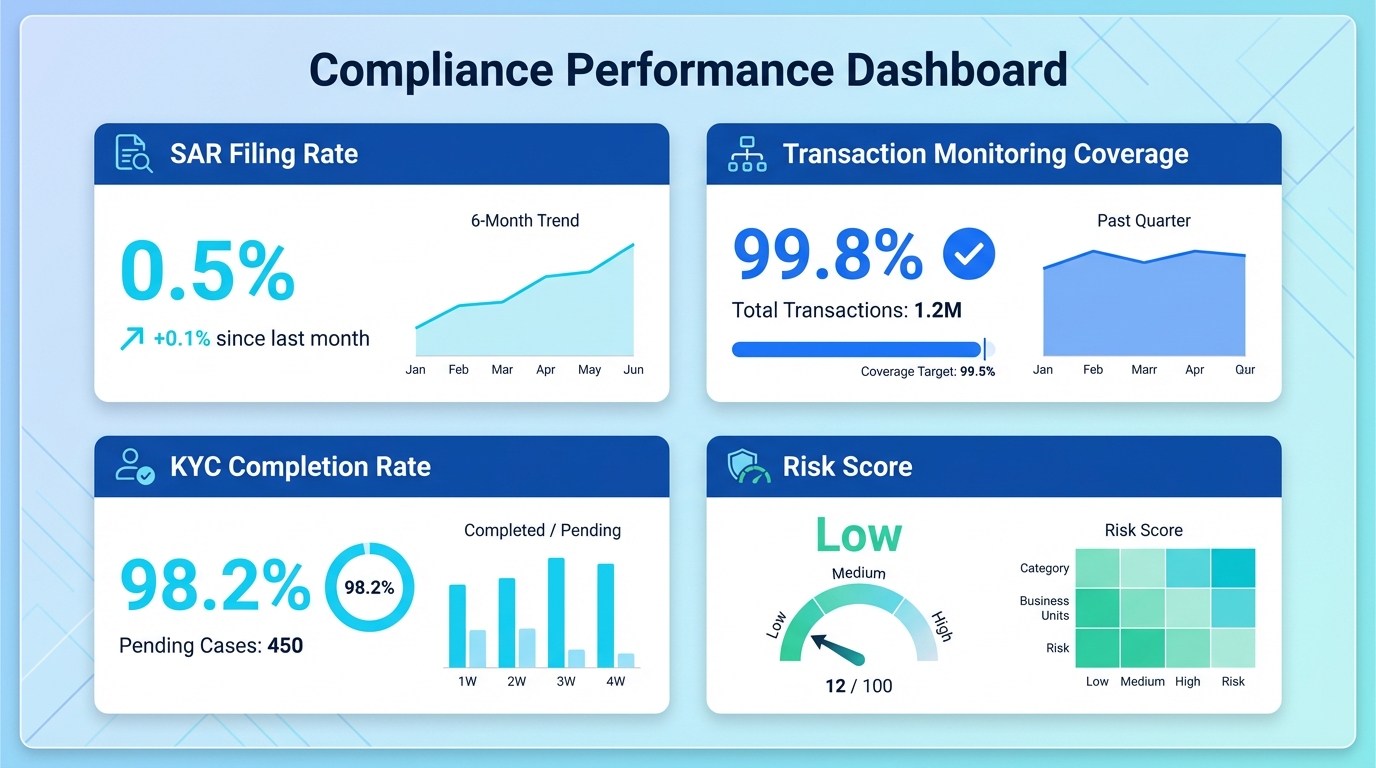
Management Reporting:
- KYC performance metrics including completion rates and timelines
- AML program effectiveness including alert rates and SAR statistics
- Risk assessment summaries with trend analysis and peer comparisons
- Regulatory examination preparedness reports and documentation
Advanced Analytics:
- Machine learning models for improved detection accuracy
- Network analysis for relationship mapping and risk assessment
- Behavioral analytics for anomaly detection and pattern recognition
- Predictive modeling for risk scoring and customer segmentation
Integration and Data Management
Data Architecture Requirements:
Real-Time Data Processing:
- Stream processing for transaction monitoring and screening
- API integration with core banking and payment systems
- Event-driven architecture for alert generation and workflow
- Data quality monitoring for completeness and accuracy
Historical Data Management:
- Data warehouse for trend analysis and investigation support
- Archive systems for regulatory retention requirements
- Backup and recovery procedures for business continuity
- Data lineage tracking for audit and compliance purposes
Integration Patterns:
- RESTful APIs for real-time system integration
- Message queues for asynchronous data processing
- ETL processes for batch data movement and transformation
- Database replication for performance and availability
Technology Selection Framework:
Build vs. Buy Analysis:
- Core competency assessment: Focus internal development on business differentiators
- Regulatory compliance requirements: Ensure solutions meet all applicable standards
- Total cost of ownership: Include implementation, maintenance, and upgrade costs
- Vendor stability and roadmap: Assess long-term viability and development plans
Integration Complexity:
- API quality and documentation: Evaluate ease of integration and ongoing maintenance
- Data format standardization: Ensure compatibility with existing systems
- Performance requirements: Verify systems can handle required transaction volumes
- Scalability planning: Assess ability to grow with business needs
The Bottom Line on Compliance Technology:
Effective compliance technology enables your program rather than constraining it. The best solutions provide comprehensive coverage while remaining flexible enough to adapt to changing regulatory requirements and business needs. Invest in platforms that will scale with your business and support your competitive differentiation.
Operational Resilience and BCP
What Is Operational Resilience?
Operational resilience is the ability of a financial institution to deliver critical operations through disruption. It goes beyond traditional business continuity planning to focus on maintaining essential services that customers and the financial system depend on, even during severe operational disruptions.
For fintechs, operational resilience means ensuring that customers can access funds, make payments, and conduct essential financial transactions even when normal operations are interrupted by technology failures, cyber incidents, natural disasters, or third-party service disruptions.
Key Operational Resilience Principles:
Critical Function Identification:
- Customer deposit and withdrawal capabilities
- Payment processing and settlement functions
- Account access and balance inquiry services
- Customer support and dispute resolution
- Regulatory reporting and compliance monitoring
Disruption Tolerance:
- Maximum acceptable downtime for each critical function
- Performance standards during disrupted operations
- Recovery time objectives and priority sequencing
- Alternative service delivery methods during disruptions
Business Continuity Planning (BCP) Requirements
Comprehensive BCP Framework:
Risk Assessment and Scenario Planning:
- Natural disasters: Earthquakes, hurricanes, floods, wildfires
- Technology disruptions: System failures, cyber attacks, data corruption
- Third-party failures: Vendor outages, payment network disruptions, cloud service interruptions
- Human resource disruptions: Pandemic, key personnel loss, workplace unavailability
- Regulatory actions: Enforcement activities, licensing restrictions, examination disruptions
Recovery Strategies:
- Alternative work locations with full operational capabilities
- Backup technology systems with current data and functionality
- Third-party relationships for critical function continuation
- Communication protocols for customers, regulators, and stakeholders
- Decision-making frameworks for crisis management and resource allocation
Testing and Validation:
- Annual comprehensive testing of complete BCP procedures
- Quarterly component testing of critical system recoveries
- Monthly communication testing to ensure contact information accuracy
- Scenario-based exercises with cross-functional teams
- Third-party coordination testing with key vendors and partners
Disaster Recovery and System Redundancy
Technology Infrastructure Resilience:
Data Center Strategy:
- Primary and secondary data centers in geographically diverse locations
- Real-time data replication with recovery point objectives (RPO) under 4 hours
- Hot standby systems capable of immediate activation
- Network redundancy with multiple internet service providers and connection types
Cloud Computing Considerations:
- Multi-zone deployment within cloud regions for availability
- Cross-region replication for disaster recovery capabilities
- Hybrid cloud strategies to avoid single vendor dependency
- Service level agreements with clear performance and availability standards
Application Architecture:
- Microservices design for component-level resilience and recovery
- Database clustering with automatic failover capabilities
- Load balancing across multiple application instances
- Circuit breakers to prevent cascade failures across system components
Incident Response and Crisis Management
Incident Response Framework:
Detection and Classification:
- Automated monitoring with immediate alert capabilities
- Incident severity levels with corresponding response procedures
- Escalation matrices with clear authority and responsibility assignments
- Communication protocols for internal teams and external stakeholders
Response Procedures:
- Immediate stabilization to prevent further damage or disruption
- Impact assessment to determine scope and affected customers
- Resource mobilization including personnel, technology, and vendor support
- Customer communication with status updates and service restoration timelines
Recovery and Restoration:
- System restoration following tested procedures and validation checkpoints
- Data integrity verification to ensure no corruption or loss occurred
- Service validation to confirm full functionality before customer access
- Post-incident review to identify improvements and prevent recurrence
Third-Party Vendor Management
Vendor Risk Management Framework:
Due Diligence Requirements:
- Financial stability assessment to ensure vendor viability
- Operational resilience evaluation of vendor BCP and disaster recovery capabilities
- Security assessment including penetration testing and vulnerability management
- Compliance validation of vendor regulatory program and audit results
- References and performance history from similar financial services clients
Ongoing Monitoring:
- Performance metrics tracking with service level agreement compliance
- Financial health monitoring through periodic financial statement review
- Security posture assessment including threat intelligence and incident reporting
- Business continuity testing including joint exercises and scenario planning
- Regulatory compliance monitoring including examination results and enforcement actions
Alternative Arrangements:
- Backup vendor relationships for critical services
- In-house capability development for essential functions
- Vendor diversification strategies to reduce concentration risk
- Termination procedures with data portability and service transition planning
Cybersecurity and Information Security
Cybersecurity Framework:
Preventive Controls:
- Multi-factor authentication for all administrative access
- Network segmentation to limit breach impact and contain threats
- Encryption standards for data at rest and in transit
- Endpoint protection with behavioral analysis and threat detection
- Vulnerability management with regular scanning and patch deployment
Detective Controls:
- Security information and event management (SIEM) with real-time monitoring
- Intrusion detection systems with behavioral analysis capabilities
- Log analysis and correlation across all system components
- Threat intelligence integration for proactive threat identification
- Security awareness training with simulated phishing and social engineering tests
Responsive Controls:
- Incident response team with defined roles and escalation procedures
- Forensic capabilities for incident investigation and evidence preservation
- Communication protocols for regulatory notification and customer communication
- Recovery procedures for system restoration and business continuity
- Lessons learned integration for continuous security improvement
Testing and Validation Requirements
Comprehensive Testing Program:
Business Continuity Testing:
- Annual full-scale exercises simulating complete operational disruption
- Quarterly component testing of critical system recovery procedures
- Monthly communication testing to verify contact information and procedures
- Vendor coordination testing to ensure third-party response capabilities
- Regulatory notification testing to confirm compliance with reporting requirements
Disaster Recovery Testing:
- Recovery time objective (RTO) validation through actual system restoration
- Recovery point objective (RPO) verification through data integrity testing
- Failover testing with live transaction processing validation
- Rollback testing to ensure ability to return to primary systems
- Performance testing to confirm acceptable service levels during recovery
Documentation and Improvement:
- Testing results documentation with detailed findings and observations
- Gap analysis and remediation planning for identified deficiencies
- Procedure updates based on testing results and lessons learned
- Training updates to incorporate new procedures and lessons learned
- Regular plan reviews to ensure alignment with business changes and regulatory requirements
Regulatory Expectations:
Federal Banking Regulators Expect:
- Board oversight of operational resilience and business continuity planning
- Regular testing with documented results and improvement actions
- Third-party management with appropriate due diligence and ongoing monitoring
- Customer communication during disruptions with clear status updates
- Regulatory notification of significant operational incidents within required timeframes
The Bottom Line on Operational Resilience:
Operational resilience isn't just about recovering from disruptions—it's about maintaining customer trust and regulatory confidence through any crisis. Fintechs with strong operational resilience programs demonstrate their maturity and reliability, which becomes a competitive advantage in customer acquisition and regulatory relationships.
Compliance Team Structure
Roles and Responsibilities
Building an effective compliance team requires clear role definition, appropriate expertise, and sufficient resources to execute your program effectively. The structure must scale with your business while maintaining the independence and authority necessary for effective compliance management.
Core Compliance Functions:
1. Compliance Leadership and Strategy
2. BSA/AML Operations and Monitoring
3. Customer Due Diligence and KYC
4. Regulatory Relations and Examination Management
5. Compliance Technology and Data Management
6. Training and Quality Assurance
Chief Compliance Officer (CCO) Requirements
Role Definition and Authority:
Primary Responsibilities:
- Overall compliance program design, implementation, and effectiveness
- Direct reporting relationship to CEO and Board of Directors
- Regulatory relationship management and examination coordination
- Risk assessment and mitigation strategy development
- Compliance culture development and organizational training
Required Qualifications:
- Experience: Minimum 7-10 years in financial services compliance
- Education: Bachelor's degree required, advanced degree or professional certification preferred
- Expertise: Deep knowledge of BSA/AML, consumer protection, and fintech regulatory requirements
- Leadership: Proven ability to build and manage compliance teams
- Communication: Strong written and verbal communication skills for regulatory interaction
Independence Requirements:
- Reporting Structure: Direct access to CEO and Board without intermediate management
- Budget Authority: Independent budget control for compliance program resources
- Investigation Authority: Ability to investigate compliance concerns without interference
- Escalation Rights: Direct communication with regulators when necessary
- Termination Protection: Cannot be terminated for compliance-related activities
BSA Officer Responsibilities
Dedicated BSA/AML Leadership:
Core Functions:
- BSA/AML program design and ongoing effectiveness assessment
- Transaction monitoring system oversight and rule calibration
- Suspicious activity investigation and SAR filing decisions
- Currency transaction reporting and record keeping
- OFAC sanctions compliance and screening oversight
Daily Operations:
- Alert Review and Investigation: Final approval for alert dispositions
- SAR Decision Making: Analysis and approval of suspicious activity reports
- Rule Calibration: Ongoing adjustment of monitoring thresholds and parameters
- Quality Assurance: Regular review of investigation quality and documentation
- Training Delivery: BSA/AML awareness and investigation training for staff
Regulatory Interaction:
- Primary point of contact for BSA/AML examination activities
- Regulatory report preparation and submission oversight
- Policy and procedure development and maintenance
- External audit coordination and finding remediation
Compliance Analyst and Investigator Roles
Investigation Team Structure:
Senior Compliance Analysts:
- Complex case investigation and analysis
- New analyst training and mentoring
- Quality review of junior analyst work
- Special project leadership and coordination
- Subject matter expertise development
Compliance Analysts:
- Transaction monitoring alert investigation
- Customer due diligence and enhanced due diligence procedures
- Documentation preparation and maintenance
- Regulatory report data compilation
- Compliance testing and validation activities
Investigation Specialists:
- Deep-dive analysis of complex suspicious activity patterns
- Multi-jurisdictional and cross-border transaction analysis
- Advanced database research and information gathering
- Law enforcement coordination and information sharing
- Expert witness testimony and legal support
Performance Standards:
- Case closure timeframes: 90% of cases closed within 30 days
- Investigation quality: Regular quality assurance review with feedback
- Documentation standards: Complete and accurate case documentation
- Regulatory reporting: Timely and accurate SAR and CTR filing
- Professional development: Ongoing training and certification maintenance
Internal Audit Function
Independent Compliance Testing:
Audit Program Scope:
- BSA/AML Program Effectiveness: Annual comprehensive review of all program components
- Transaction Monitoring Testing: Validation of monitoring rule effectiveness and coverage
- Customer Due Diligence Testing: Sample-based review of KYC procedures and documentation
- Regulatory Compliance Testing: Adherence to all applicable regulatory requirements
- Training Program Assessment: Evaluation of training effectiveness and competency development
Independence Requirements:
- Reporting Structure: Direct reporting to Audit Committee of Board of Directors
- Resource Independence: Separate budget and personnel from compliance operations
- Investigation Authority: Unrestricted access to systems, records, and personnel
- External Validation: Periodic third-party review of audit program effectiveness
Board Oversight and Governance
Board-Level Responsibilities:
Compliance Committee Structure:
- Committee Composition: Independent directors with relevant financial services experience
- Meeting Frequency: Quarterly meetings with additional meetings as needed
- Information Flow: Regular reporting from CCO and internal audit function
- Decision Authority: Approval of compliance program changes and resource allocation
Oversight Activities:
- Program Effectiveness Review: Annual assessment of compliance program performance
- Risk Tolerance Setting: Establishment of risk appetite and tolerance levels
- Resource Allocation: Approval of compliance budget and staffing levels
- Regulatory Relationship: Direct communication with primary regulator when appropriate
- Corrective Action Oversight: Monitoring of examination finding remediation
Training and Development Programs
Comprehensive Training Framework:
New Employee Onboarding:
- BSA/AML Awareness: Basic understanding of money laundering and terrorist financing risks
- Customer Due Diligence: KYC procedures and enhanced due diligence requirements
- Suspicious Activity Recognition: Red flags and escalation procedures
- Consumer Protection: Fair lending, privacy, and consumer rights
- Role-Specific Training: Detailed training for compliance-specific responsibilities
Ongoing Training Requirements:
- Annual BSA/AML Training: Updated for regulatory changes and emerging risks
- Quarterly Updates: New risks, regulatory guidance, and policy changes
- Role-Based Training: Specialized training for specific job functions
- External Training: Industry conferences, regulatory seminars, and professional development
- Certification Maintenance: Support for professional certifications and continuing education
Training Effectiveness Measurement:
- Competency Testing: Regular assessment of knowledge retention and application
- Performance Correlation: Analysis of training effectiveness and job performance
- Feedback Collection: Employee feedback on training quality and relevance
- Continuous Improvement: Regular training program updates based on effectiveness data
Organizational Structure Considerations:
Scaling the Compliance Team:
- Startup Stage (1-50 employees): Part-time CCO or consultant with outsourced operations
- Growth Stage (50-200 employees): Full-time CCO with 1-2 analysts
- Expansion Stage (200-500 employees): CCO, BSA Officer, and 3-5 analysts
- Mature Stage (500+ employees): Full compliance department with specialized roles
Cross-Training and Succession Planning:
- Knowledge Transfer: Documentation and cross-training for critical functions
- Career Development: Clear progression paths for compliance professionals
- Succession Planning: Identified successors for key compliance positions
- External Relationships: Professional networks and industry participation
The Bottom Line on Team Structure:
Your compliance team is your first line of defense against regulatory risk and your primary interface with regulatory authorities. Invest in experienced professionals, provide them with adequate resources and independence, and structure the team to scale with your business growth.
Common Compliance Pitfalls
Underinvesting in Compliance Infrastructure
The False Economy of Compliance Cost-Cutting:
Many fintechs treat compliance as a necessary cost rather than a strategic investment, leading to systematic underinvestment that creates significant long-term risks and costs.
Common Underinvestment Patterns:
Staffing Shortcuts:
- Part-time compliance officers for full-time responsibilities
- Inexperienced staff in critical compliance roles
- Insufficient analyst coverage for investigation volumes
- No backup coverage for key compliance functions
- Delayed hiring despite business growth and increased complexity
Technology Underinvestment:
- Manual processes where automation is available and cost-effective
- Legacy systems that cannot handle current transaction volumes or complexity
- Inadequate integration between compliance and business systems
- Insufficient data quality controls and validation procedures
- Limited reporting capabilities for management oversight and regulatory reporting
The True Cost of Underinvestment:
Regulatory Risk:
- Higher examination findings and enforcement risk
- Extended examination periods and increased regulatory attention
- Potential business restrictions or growth limitations
- Reputational damage from compliance failures
Operational Inefficiency:
- Manual processes that don't scale with business growth
- Higher error rates and rework costs
- Delayed customer onboarding and increased abandonment
- Increased investigation time and costs
Opportunity Cost:
- Slower product development and market entry
- Limited business model flexibility due to compliance constraints
- Reduced competitive advantage from compliance capabilities
- Higher long-term remediation costs
Reactive vs. Proactive Compliance
The Reactive Compliance Trap:
Characteristics of Reactive Compliance:
- Issue-driven priorities rather than risk-based planning
- Minimal investment until problems are identified
- Crisis management approach to regulatory relationships
- Limited forward planning for business changes and growth
- Defensive mindset focused on avoiding problems rather than enabling business
Consequences of Reactive Approaches:
- Higher total costs due to crisis-driven responses and remediation
- Limited business flexibility when compliance becomes a constraint rather than enabler
- Poor regulatory relationships characterized by problems rather than proactive cooperation
- Competitive disadvantage when compliance capabilities limit business opportunities
Building Proactive Compliance:
Risk-Based Planning:
- Forward-looking risk assessment considering business plans and market changes
- Scenario planning for potential regulatory changes and business growth
- Investment planning aligned with business strategy and growth projections
- Capability development ahead of business need rather than in response to problems
Regulatory Relationship Management:
- Regular communication with regulatory contacts beyond examination periods
- Proactive disclosure of compliance program changes and enhancements
- Industry participation in regulatory discussions and guidance development
- Thought leadership positioning through speaking and writing on compliance topics
Documentation and Record-Keeping Failures
The Critical Importance of Documentation:
Regulatory Expectation: If it's not documented, it didn't happen. Regulators evaluate compliance program effectiveness primarily through documentation review.
Common Documentation Failures:
Inadequate Policies and Procedures:
- Generic templates that don't reflect actual business operations
- Outdated procedures that haven't been updated for business changes
- Incomplete coverage of required compliance program elements
- Unclear responsibilities and decision-making authority
- Missing implementation guidance for staff execution
Investigation Documentation Shortcomings:
- Incomplete analysis of suspicious activity patterns
- Missing documentation of information sources and verification steps
- Unclear decision rationale for alert dispositions and SAR decisions
- Inadequate follow-up documentation for ongoing monitoring decisions
- Poor organization making it difficult to locate and review case information
Training and Competency Records:
- Incomplete training records for compliance program requirements
- Missing competency assessments for compliance staff
- Outdated training materials that don't reflect current requirements
- Inadequate documentation of training effectiveness and remediation
Communication Breakdowns with Regulators
Building Effective Regulatory Relationships:
Common Communication Problems:
Inadequate Preparation:
- Insufficient documentation for examination requests
- Unprepared personnel for regulatory interviews and discussions
- Incomplete understanding of regulatory expectations and requirements
- Poor presentation of compliance program effectiveness and capabilities
Defensive Positioning:
- Minimizing problems rather than demonstrating understanding and remediation
- Blame shifting to vendors or circumstances rather than accepting responsibility
- Resistance to feedback and recommendations from regulatory staff
- Inadequate follow-up on commitments made during examinations
Best Practices for Regulatory Communication:
Proactive Engagement:
- Regular updates on compliance program changes and enhancements
- Early notification of significant compliance issues or concerns
- Request for guidance on new products or business model changes
- Industry participation in regulatory outreach and guidance development
Professional Presentation:
- Well-organized documentation that clearly demonstrates program effectiveness
- Knowledgeable spokespersons who can explain program design and implementation
- Honest assessment of program strengths and areas for improvement
- Specific improvement plans with timelines and accountability measures
Technology Integration Challenges
The Complexity of Compliance Technology:
Integration Failures:
- Data silos that prevent comprehensive risk assessment and monitoring
- Manual data transfers that introduce errors and delays
- Inconsistent data formats that complicate analysis and reporting
- Limited real-time capabilities for timely decision-making
- Poor user interfaces that reduce staff efficiency and effectiveness
Vendor Management Issues:
- Over-reliance on single vendors creating concentration risk
- Inadequate service level agreements for critical compliance functions
- Poor vendor oversight and performance management
- Limited contingency planning for vendor failures or service disruptions
Solutions for Integration Challenges:
Architecture Planning:
- Comprehensive data architecture design before system selection
- API-first integration approach for flexibility and scalability
- Real-time data processing capabilities for timely decision-making
- Comprehensive testing before production implementation
- Ongoing performance monitoring and optimization
Scaling Compliance with Business Growth
The Scalability Challenge:
Common Scaling Failures:
- Linear staffing approaches that don't leverage technology and automation
- Process limitations that become bottlenecks as volumes increase
- Technology constraints that cannot handle increased transaction volumes
- Geographic expansion without adequate compliance infrastructure
- Product diversification without corresponding compliance program updates
Scalable Compliance Design:
Process Automation:
- Automated data collection and analysis where possible
- Workflow automation for routine compliance tasks
- Exception-based management focusing human resources on high-risk activities
- Self-service capabilities for routine customer interactions
- Predictive analytics for resource planning and risk identification
Organizational Design:
- Centralized expertise with distributed execution capabilities
- Clear escalation procedures that don't create bottlenecks
- Cross-training programs to provide operational flexibility
- Technology-enabled collaboration for geographically distributed teams
- Performance metrics that scale with business volume and complexity
The Bottom Line on Compliance Pitfalls:
Most compliance failures result from systematic problems rather than individual mistakes. Building awareness of common pitfalls and implementing proactive measures to avoid them significantly reduces regulatory risk and improves compliance program effectiveness.
The Future of Fintech Compliance
Emerging Regulatory Trends
The regulatory landscape for fintech compliance is evolving rapidly, driven by technological innovation, changing risk patterns, and lessons learned from recent industry challenges. Understanding these trends is essential for building compliance programs that remain effective and competitive.
Key Regulatory Developments:
Enhanced Operational Resilience Requirements:
Building on lessons from recent infrastructure incidents, regulators are implementing more rigorous operational resilience standards that require:
- Critical function identification with specific recovery time objectives
- Stress testing of operational capabilities under adverse scenarios
- Third-party dependency mapping and concentration risk management
- Incident response capabilities with regulatory notification requirements
Digital Asset and Cryptocurrency Compliance:
As digital assets become more mainstream, regulatory frameworks are evolving to address:
- Stablecoin regulation with reserve requirements and operational standards
- DeFi protocol oversight for traditional financial service functions
- Cross-border compliance for digital asset transactions
- Environmental, Social, and Governance (ESG) considerations for cryptocurrency operations
Open Banking and Data Sharing:
Following international trends, U.S. regulators are developing frameworks for:
- Customer data portability rights and technical standards
- Third-party access to customer account information
- API security standards for financial data sharing
- Consumer protection in open banking arrangements
Technology's Role in Compliance Evolution
Artificial Intelligence and Machine Learning in AML:
Advanced Detection Capabilities:
- Behavioral analytics that adapt to changing customer patterns
- Network analysis for complex relationship mapping and risk assessment
- Natural language processing for investigation efficiency and accuracy
- Predictive modeling for proactive risk identification and prevention
Implementation Considerations:
- Model governance requirements for AI/ML system oversight
- Explainability standards for regulatory examination and audit
- Data quality requirements for effective model performance
- Bias detection and mitigation to ensure fair treatment
Regulatory Technology (RegTech) Innovations:
Automated Compliance Processes:
- Real-time regulatory reporting with automated data compilation
- Dynamic risk assessment that adjusts to changing business conditions
- Automated policy updates based on regulatory change monitoring
- Compliance testing automation for ongoing program validation
Cloud-Based Compliance Solutions:
- Scalable infrastructure that grows with business needs
- Shared compliance intelligence across industry participants
- Reduced implementation time for new compliance capabilities
- Cost efficiency through shared infrastructure and development costs
AI and Machine Learning in AML
Advanced Analytics Applications:
Anomaly Detection:
- Unsupervised learning to identify previously unknown suspicious patterns
- Clustering analysis to group similar activities and identify outliers
- Time series analysis for trend identification and pattern recognition
- Multi-dimensional analysis considering multiple risk factors simultaneously
Entity Resolution and Network Analysis:
- Relationship mapping to identify hidden connections between entities
- Risk propagation modeling to assess how risk spreads through networks
- Community detection to identify suspicious actor groups
- Graph analytics for complex transaction pattern analysis
Implementation Best Practices:
Data Foundation:
- Comprehensive data collection from all relevant sources
- Data quality management to ensure model accuracy
- Feature engineering to extract relevant patterns from raw data
- Real-time data processing for timely detection and response
Model Management:
- Regular model validation and performance monitoring
- Bias testing and mitigation to ensure fair and accurate results
- Interpretability tools for regulatory explanation and audit
- Governance frameworks for model approval and oversight
Regulatory Technology (RegTech) Innovations
Emerging RegTech Categories:
Regulatory Intelligence:
- Automated rule interpretation from regulatory guidance and requirements
- Impact analysis for regulatory changes on existing compliance programs
- Regulatory calendar management for upcoming requirement implementation
- Cross-jurisdictional compliance mapping for multi-state or international operations
Compliance Automation:
- Automated control testing for ongoing compliance validation
- Exception management with workflow and escalation capabilities
- Performance monitoring with predictive analytics for compliance risks
- Resource optimization through automated task prioritization and allocation
Digital Identity and Authentication:
- Biometric verification with liveness detection and fraud prevention
- Blockchain-based identity for secure and portable customer verification
- Zero-knowledge proof systems for privacy-preserving compliance
- Decentralized identity frameworks for customer control and consent
Global Harmonization Efforts
International Regulatory Coordination:
Financial Action Task Force (FATF) Standards:
- Global AML/CFT requirements with consistent implementation expectations
- Risk-based approach guidance for proportionate compliance measures
- Beneficial ownership transparency requirements for entity customers
- Virtual asset regulation for cryptocurrency and digital asset transactions
Cross-Border Data Sharing:
- Suspicious activity information sharing agreements between jurisdictions
- Correspondent banking due diligence and information exchange
- Tax information automatic exchange under Common Reporting Standard (CRS)
- Law enforcement cooperation through formal and informal channels
Regulatory Sandbox Programs:
- Innovation-friendly testing environments for new financial products
- Temporary regulatory relief for pilot programs and proof-of-concept development
- Cross-border coordination for international fintech companies
- Knowledge sharing between regulators and industry participants
Preparing for Tomorrow's Requirements
Future-Ready Compliance Programs:
Adaptive Architecture:
- Modular compliance systems that can accommodate new requirements
- API-based integration for rapid system updates and enhancements
- Cloud-native deployment for scalability and flexibility
- Real-time processing capabilities for immediate compliance decision-making
Continuous Learning Organizations:
- Regulatory monitoring systems for early identification of changes
- Industry participation in regulatory development and consultation processes
- Cross-functional collaboration between compliance, technology, and business teams
- External partnerships with RegTech vendors and compliance service providers
Risk-Based Resource Allocation:
- Dynamic risk assessment that adjusts compliance resources to changing threats
- Predictive analytics for resource planning and capacity management
- Outcome-based metrics that demonstrate program effectiveness rather than just activity
- Cost-benefit analysis for compliance investment decisions
Strategic Compliance Planning:
Three-Year Compliance Roadmap:
- Regulatory horizon scanning for anticipated requirement changes
- Technology upgrade planning aligned with business growth and regulatory needs
- Staff development planning for changing skill requirements
- Vendor relationship planning for evolving service needs
Investment Prioritization:
- Risk-adjusted returns for compliance technology investments
- Strategic value assessment beyond pure regulatory compliance
- Integration planning for comprehensive compliance platforms
- Change management for organizational adaptation to new requirements
The Bottom Line on Future Compliance:
The future of fintech compliance management will be characterized by increased automation, more sophisticated analytics, and closer integration between compliance and business operations. Companies that invest in adaptive compliance infrastructure today will have significant competitive advantages as regulatory requirements become more complex and demanding.
Success in future compliance will require not just meeting today's requirements, but building the capabilities to adapt quickly to tomorrow's challenges.
Conclusion: Compliance as Competitive Advantage
Compliance isn't a cost center—it's a strategic investment that separates market leaders from market followers. After 15 years in financial services compliance, I've observed that companies with the strongest compliance programs don't just manage risk better—they move faster, compete more effectively, and build more sustainable businesses.
The Strategic Reality:
While competitors struggle with vendor limitations, regulatory uncertainty, and inherited compliance problems, companies with owned compliance programs design solutions that enable their business model while meeting regulatory requirements. This is the competitive advantage that middleware dependency simply cannot provide.
The Three Pillars of Compliance Excellence:
1. Ownership - Direct Control of Compliance Program and Regulatory Relationships
When you own your compliance program, you control the design, implementation, and evolution of your risk management approach. You maintain direct relationships with regulators, participate in policy development, and position your company as a thought leader rather than a follower.
2. Investment - Adequate Resources and Technology to Execute Effectively
Compliance programs that enable business growth require proper investment in people, technology, and processes. The companies that view compliance as an investment in competitive advantage consistently outperform those that view it as a necessary cost.
3. Culture - Compliance-First Mindset Embedded Throughout Organization
The most effective compliance programs create a culture where compliance considerations are integrated into every business decision from the beginning, not added as an afterthought or constraint.
The Competitive Advantages of Compliance Excellence:
Speed to Market:
Companies with mature compliance programs launch new products faster because they understand regulatory requirements and have the infrastructure to meet them from day one.
Regulatory Relationships:
Direct, proactive relationships with regulators create trust and collaboration that benefits the entire business, from examination processes to new product guidance.
Customer Trust:
Strong compliance programs create customer confidence that translates to higher acquisition rates, lower churn, and stronger brand value.
Investor Confidence:
Sophisticated investors recognize that compliance excellence reduces regulatory risk and creates sustainable competitive advantages that support long-term value creation.
Risk-Taking Capability:
Counterintuitively, companies with the strongest compliance programs can take the most calculated risks because they understand the regulatory landscape and have the capabilities to manage complex compliance challenges.
My Personal Perspective:
"The best compliance programs aren't the most restrictive—they're the most enabling. When you own your compliance program, you can design it to support your business model while meeting regulatory requirements. You become a partner with regulators rather than a subject of enforcement. You turn compliance from a constraint into a competitive weapon."
"I've seen companies transform from regulatory laggards to industry leaders simply by investing properly in compliance infrastructure and taking ownership of their regulatory destiny. The difference isn't just in risk management—it's in business performance."
Your Next Steps:
Fintech compliance management and regulatory compliance ownership aren't just about avoiding problems—they're about building the foundation for sustainable competitive advantage. Companies that understand this distinction and act on it will dominate their markets.
Don't let compliance limitations constrain your business potential. The regulatory environment will only become more complex and demanding. The companies that build compliance excellence today will have the competitive advantages tomorrow.
Ready to Transform Your Compliance Program?
Our team has helped dozens of fintechs build world-class compliance programs that enable rather than constrain business growth. We understand the challenges because we've faced them ourselves, and we know the opportunities because we've helped companies achieve them.
[Download: Fintech Compliance Program Assessment Tool]
Evaluate your current compliance program against industry best practices and identify opportunities for competitive advantage through compliance excellence.
[Schedule Compliance Consultation]
Discuss your specific compliance challenges and opportunities with our team of experienced compliance professionals.
About the Author
Tyler Ferguson, Head of Compliance, Chisel
Tyler brings over 15 years of financial services compliance experience, spanning traditional banking and fintech innovation. As Chisel's Head of Compliance, Tyler leads the development of compliance frameworks that enable fintechs to own their regulatory destiny without sacrificing operational efficiency.
Prior to Chisel, Tyler served as Chief Compliance Officer for multiple fintech companies, navigating regulatory examinations, building BSA/AML programs from scratch, and advising boards on risk management strategies. His experience includes direct collaboration with federal and state regulators, audit firms, and legal counsel across diverse financial products.
Tyler holds CAMS (Certified Anti-Money Laundering Specialist) and CFE (Certified Fraud Examiner) certifications and frequently speaks at industry conferences on fintech compliance best practices.
Connect with Tyler:
- LinkedIn
- Learn more about Chisel's Compliance Team
Published: January 2026 | Last Updated: January 2026
Reading Time: 16 minutes | Word Count: 3,650
Tags: #fintech compliance #risk management #BSA/AML #regulatory compliance #compliance program
Frequently Asked Questions
Q: What are the minimum compliance requirements for a fintech startup?
A: The minimum requirements depend on your business model and transaction volume, but typically include: a designated BSA Officer, written BSA/AML policies and procedures, customer identification program, transaction monitoring capabilities, suspicious activity reporting procedures, and compliance training program. However, "minimum compliance" is often insufficient for business growth and competitive positioning.
Q: How much should we budget for compliance as a percentage of revenue?
A: Industry benchmarks suggest 2-5% of revenue for mature fintechs, but startups often need to invest 5-10% during initial program development. The key is viewing compliance as an investment in competitive infrastructure rather than just a cost center. Companies with strong compliance programs often achieve better unit economics and faster growth.
Q: Do we need a full-time CCO from day one?
A: Not necessarily for very early-stage companies, but you need dedicated compliance expertise as soon as you begin handling customer funds or transactions. Many successful companies start with part-time or consulting arrangements but transition to full-time leadership as they reach $10M+ in transaction volume or 1,000+ customers.
Q: What's the difference between BSA and AML, and why does it matter?
A: The Bank Secrecy Act (BSA) is the U.S. law that requires financial institutions to assist government agencies in detecting money laundering. Anti-Money Laundering (AML) refers to the policies and procedures implemented to comply with BSA requirements. BSA is the legal framework; AML is the operational response. Both are essential components of your compliance program.
Q: How often should we file Suspicious Activity Reports (SARs)?
A: There's no target number for SAR filings—the frequency should reflect your actual risk profile and customer base. However, filing zero SARs is usually problematic (suggests inadequate monitoring), while filing excessive SARs may indicate poor calibration. Most healthy programs file SARs at a rate of 0.1-1% of active customers annually.
Q: What are the potential penalties for compliance failures?
A: Penalties can range from examination findings requiring corrective action to civil monetary penalties of $25,000+ per violation, criminal prosecution for willful violations, and business restrictions including account closure requirements. However, the indirect costs—reputational damage, customer loss, business restrictions—often exceed direct penalties.
Q: Can we outsource compliance functions to reduce costs and complexity?
A: You can outsource certain compliance operations, but you cannot outsource compliance responsibility or accountability. Outsourcing can be effective for specific functions like transaction monitoring or investigation support, but strategic compliance decisions and regulatory relationships should remain in-house. Wholesale compliance outsourcing often creates more risk than it eliminates.
Q: How do we prepare for regulatory examinations?
A: Preparation starts with maintaining examination-ready documentation throughout the year, not just before examinations. Key elements include: current policies and procedures, compliance testing results, training records, investigation files, regulatory correspondence, board meeting minutes, and corrective action documentation. Most importantly, ensure your compliance officer can clearly explain program design and demonstrate effectiveness.
Q: What compliance technology should we invest in first?
A: Start with foundational capabilities: customer identification and verification systems, basic transaction monitoring, and case management tools. Avoid the temptation to build everything in-house initially—leverage proven solutions for

